Chicalaba (Mesoamerican Giant-Acorn Oak)
Quercus insignis
Quick facts
Native Region
Southern Mexico to western Panama (Mesoamerican montane cloud forests)
Max Height
20-30 m (occasionally to 40 m)
Family
Fagaceae
Conservation
EN — Endangered
Uses
Safety Information
Toxicity Details
Like all oaks, chicalaba acorns and young leaves contain tannins (including gallotannins that hydrolyze to gallic acid), which are mildly toxic if consumed raw in quantity. In humans, casual acorn tasting is not a medical emergency but can cause nausea, stomach upset, or constipation; the bitterness of raw tannins is itself a strong natural deterrent to overconsumption. Tannins can be leached out by soaking and prolonged cooking, a preparation method documented for acorns of other oak species used as human food. There is no source-verified record of chicalaba acorns being prepared as a traditional Costa Rican food; this description is a general-oak safety note, not a claim of local culinary use.
Skin Contact Risks
No documented skin irritation from bark, wood, or leaf contact. Handling fresh acorns and foliage is considered safe.
Allergenic Properties
Moderate allergen risk. Oaks are wind-pollinated (anemophilous) and produce fine pollen that is a recognized seasonal allergen trigger for hay-fever-sensitive individuals in oak-forest regions; sensitivity varies by person and exposure level.
Wildlife & Pet Risks
Documented in veterinary literature for the genus Quercus broadly: acorn tannins can cause gastrointestinal upset (vomiting, diarrhea, abdominal pain) in dogs, and in cattle and horses that graze heavily on acorns or wilted oak leaves, tannin-related kidney and liver injury has been reported in temperate-zone oak species. No species-specific veterinary case reports for Quercus insignis were found in this review; treat with the same general caution recommended for oaks. Wildlife adapted to the ecosystem — squirrels, acorn woodpeckers, and other scatter-hoarding birds and mammals — rely on chicalaba's oversized acorns as a normal, non-toxic food source.
Season
Flowering
Mar-May
Fruiting
Jul-Aug
How to identify
Chicalaba (Mesoamerican Giant-Acorn Oak)
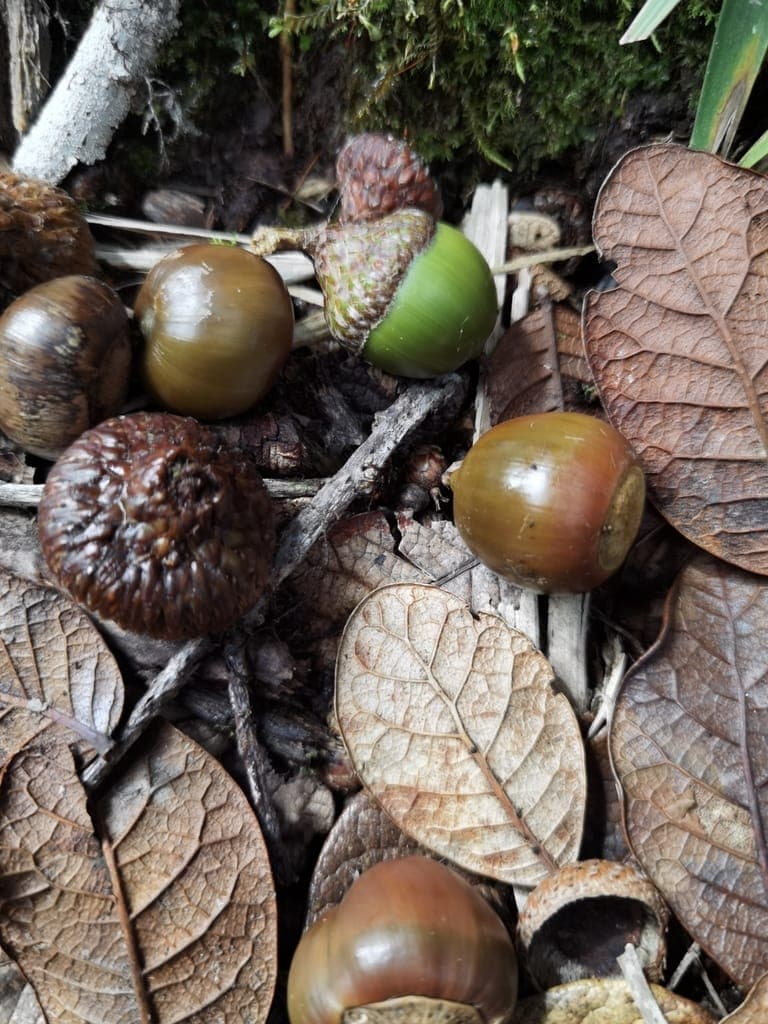
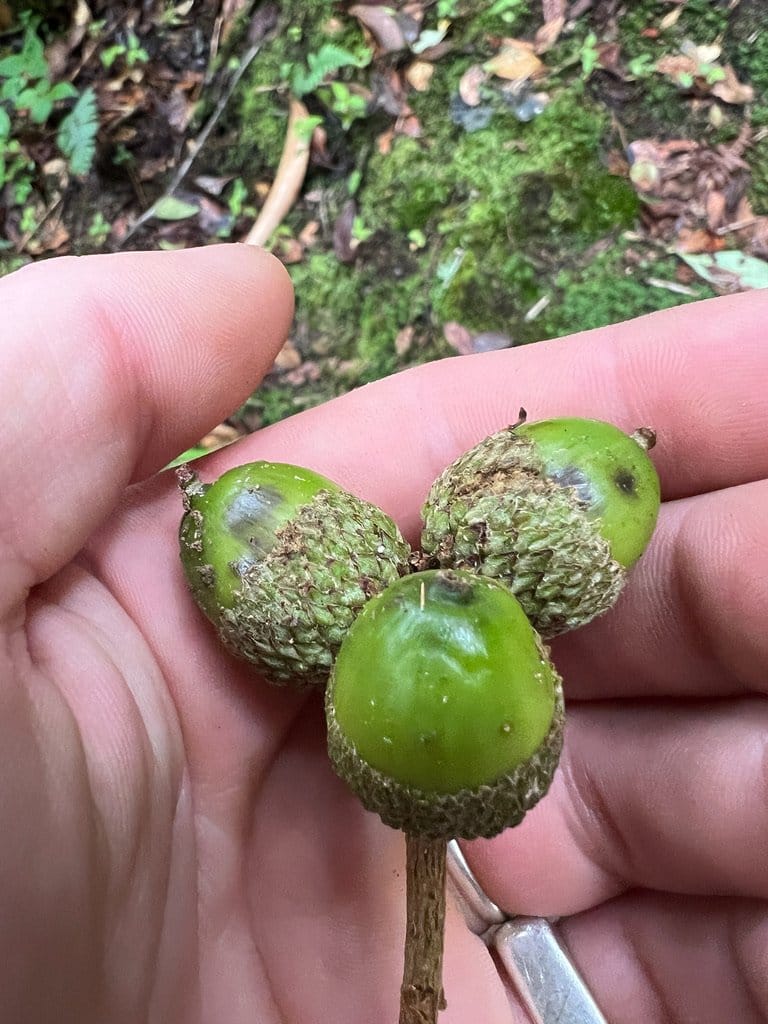
Chicalaba (Quercus insignis) produces acorns up to 10-12 centimeters across — roughly the size of a large egg or small orange — the biggest of any of the world's ~450 oak species (Trees and Shrubs Online, Royal Botanic Garden Edinburgh). It grows in Costa Rica's highland cloud forests between roughly 1,000 and 2,400 m, and it is assessed Endangered on the IUCN Red List (Jerome, 2018). Chicalaba is a single, scientifically named oak species — distinct from the general "Roble Encino" highland-oak group profiled elsewhere in this atlas, and unrelated to Roble de Sabana (Tabebuia rosea), which is not an oak at all.
Quick Reference
iNaturalist Observations
Community-powered species data
📸 Photo Gallery
Leaves
📷 (c) wild_aliss, some rights reserved (CC BY)(CC BY)
View source ↗Leaf underside detail
📷 (c) aandmg, some rights reserved (CC BY-NC)(CC BY-NC)
View source ↗Fruit
📷 (c) Joey Santore, some rights reserved (CC BY-NC)(CC BY-NC)
View source ↗Mature acorn
📷 (c) aandmg, some rights reserved (CC BY-NC)(CC BY-NC)
View source ↗Young acorns
📷 (c) mattiexoxo, some rights reserved (CC BY-NC)(CC BY-NC)
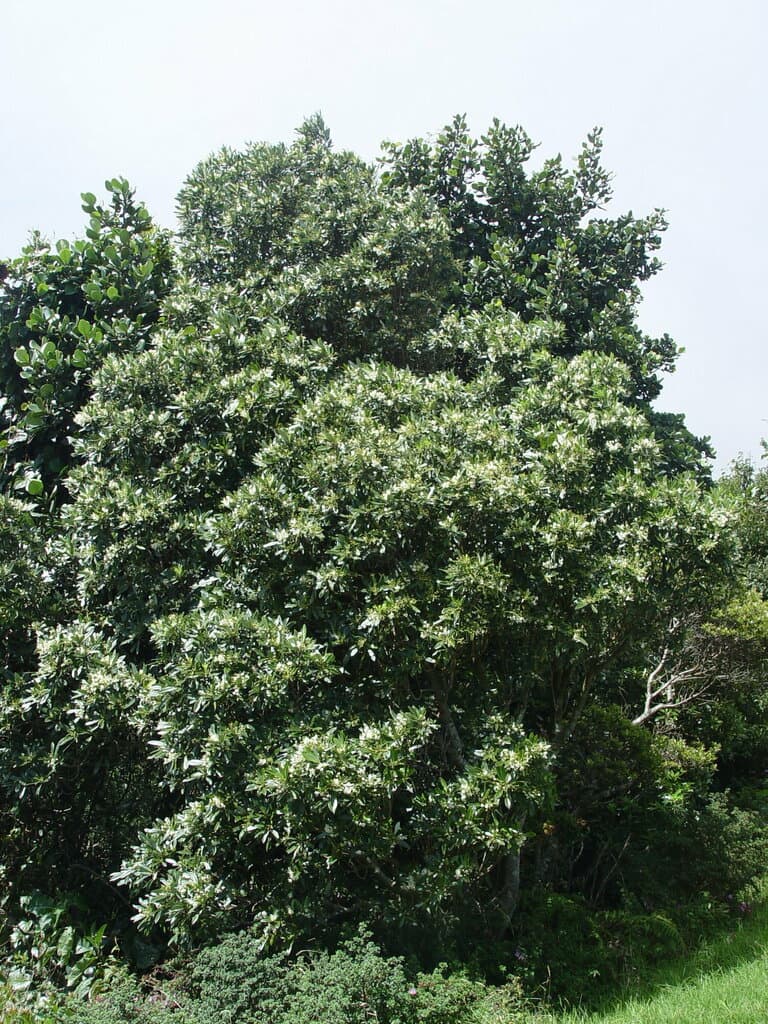
View source ↗Photos sourced from iNaturalist's community science database (leaves and fruit, including the species' distinctive giant acorns at two growth stages). Chicalaba is a rare, remote-growing Endangered oak, and this atlas was not able to source a dedicated whole-tree, bark, or flower photo under a compatible open license at time of publication — the gallery above covers what real, properly-licensed observations were available. Browse all Chicalaba observations in Costa Rica →↗ (187 total). If you have additional quality images — a whole-tree shot or bark detail in particular — please contribute through our photo submission page.
Taxonomy
Unlike this atlas's "Roble Encino" profile — which intentionally covers ~25 Costa Rican Quercus species as a group — Chicalaba is a single, formally described species: Quercus insignis M.Martens & Galeotti, published in 1843. It is also entirely unrelated to Roble de Sabana (Tabebuia rosea, family Bignoniaceae), which shares the Spanish word "roble" but is not an oak.
Common Names by Region
No indigenous-language name for this species was identified in the sources consulted for this page (POWO, GBIF, IUCN, Trees and Shrubs Online, Oak Compendium, academic literature). If a Bribrí, Cabécar, or other indigenous name for Chicalaba exists, it has not yet been documented here and would require review under this atlas's indigenous knowledge governance policy before addition.
Etymology and Taxonomic Notes
- Genus Quercus: the classical Latin name for oak.
- Species epithet insignis: Latin for "remarkable" or "distinguished" — a fitting name, given the record-setting acorn.
- Authorities: Belgian botanists Martin Martens and Henri Guillaume Galeotti, who published the species in the Bulletin de l'Académie Royale des Sciences et Belles-Lettres de Bruxelles 10(1): 219 (1843), based on Galeotti's Mexican collections.
- Section: placed in Quercus section Quercus (the white oaks), per Plants of the World Online (Kew).
- Synonyms recognized by POWO include Quercus schippii Standl., Quercus seibertii C.H.Mull., and Quercus strombocarpa Liebm. — names given to regional collections before they were consolidated under Q. insignis.
- Hybridization: the Oak Compendium (Global Conservation Consortium for Oak) notes documented hybridization with Quercus lancifolia, producing Quercus × galeottii where the two species' ranges overlap.
Geographic Distribution
Geographic Distribution
Chicalaba's native range runs from central Mexico (Jalisco, Nayarit, Guerrero, Oaxaca, Veracruz, Chiapas) through Belize, Guatemala, Honduras, Nicaragua, Costa Rica, and into western Panama — essentially the length of the Mesoamerican highland cloud-forest corridor (GBIF distribution record, sourced to the World Checklist of Vascular Plants; Trees and Shrubs Online). Populations are naturally patchy and low-density throughout this range: the species rarely forms pure stands, more often turning up as scattered individuals or small groups within mixed cloud-forest canopy.
Where Chicalaba Grows in Costa Rica
Known and likely habitat:
Elevation: Sources give somewhat different bands for the species' full range — Trees and Shrubs Online cites 900-2,000 m; the Oak Compendium cites 200-2,000 m; the International Oak Society cites 200-1,700 m. Within Costa Rica specifically, Chicalaba is associated with the montane cloud-forest belt, roughly 1,000-2,400 m, overlapping the lower-to-mid range of the country's oak-forest ecoregion.
Costa Rica's montane oak forest ecoregion (Talamanca and Central Volcanic highlands, roughly 1,000-2,400 m) was, prior to this page, the single most under-covered ecoregion in this atlas — none of the existing 175 species had a documented minimum elevation of 2,000 m or higher. Chicalaba is the first page in the atlas to profile a named, species-level highland oak.
Habitat
Chicalaba is a canopy or sub-canopy tree of tropical montane cloud forest — the same fog-immersed, epiphyte-rich habitat that defines Costa Rica's high-elevation forest ecosystems. The Rufford Foundation's field-research summary of the species describes its cloud-forest habitat as "exceptionally biodiverse," supporting other threatened plant species alongside the oaks themselves. Unlike Costa Rica's higher-elevation oaks (Quercus costaricensis, Q. copeyensis), which dominate the páramo-adjacent forest above roughly 2,500 m, Chicalaba occupies a somewhat lower and broader elevational band, putting it in closer contact with agricultural frontiers and human settlement — a key factor in its conservation status (see below).
Botanical Description
How to Identify
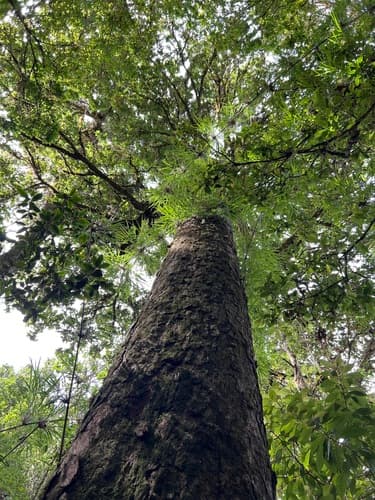
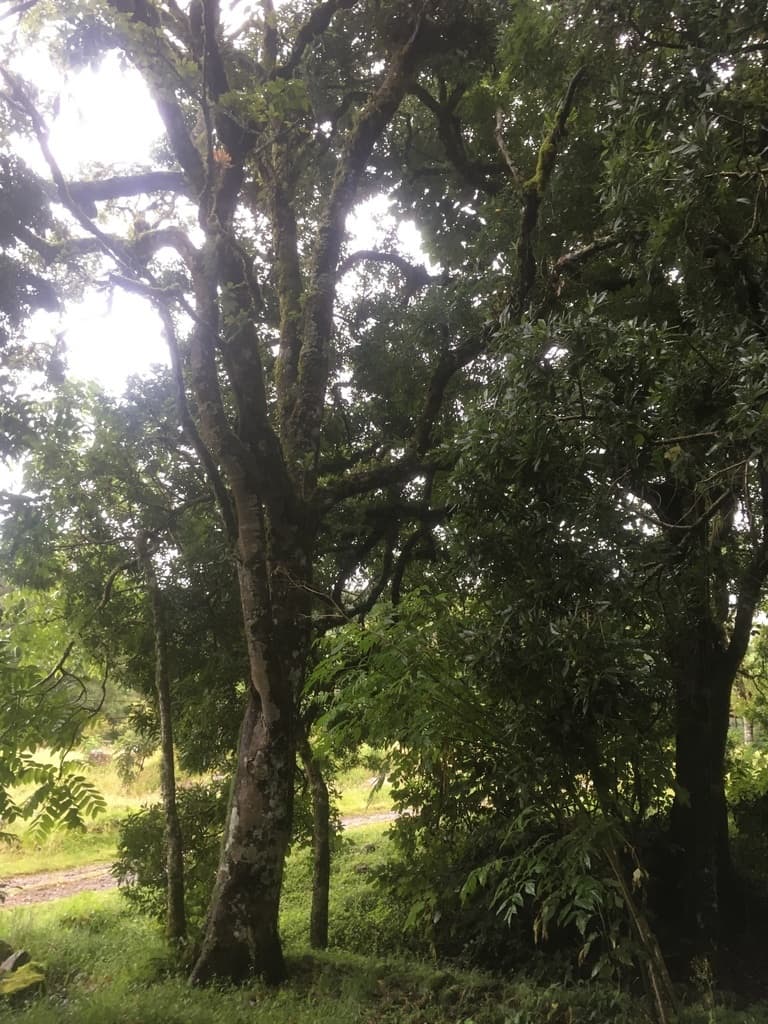
The acorn is the giveaway: no other Costa Rican tree — oak or otherwise — produces anything close to a 10 cm nut with a large, scaly, bur-like cap. Where fallen acorns are not present, look for the combination of elevation (roughly 1,000-2,400 m, cloud forest), a straight-trunked canopy oak with a rounded crown, and leaves with a shiny upper surface, woolly underside, and wavy-to-entire margins.
Ecological Role
Chicalaba functions as part of the montane oak-cloud-forest canopy that Costa Rica's high-elevation biodiversity depends on. As with the country's other highland oaks, large old chicalaba trees can host substantial epiphyte loads — orchids, bromeliads, ferns, and mosses — and their canopies contribute to the fog-stripping (cloud moisture capture) that helps sustain cloud-forest hydrology.
Wildlife and the Giant Acorn
Shared Habitat with the Resplendent Quetzal
Uses and Applications
Chicalaba's Endangered status and low population density mean it is not a significant commercial timber or food species today. The uses documented below are drawn from the sources cited; where this atlas could not find independent verification for a plausible-sounding claim (for example, specific traditional Costa Rican culinary preparation of the acorns), it has been left out rather than assumed.
Fuelwood and Local Use
An oak-focused summary from Botanical Realm's plant-identification profile states that acorns "have been used for food" and that wood has been used "for tools and structures" by local communities within the species' broad Mesoamerican range; this is presented there as a general historical note rather than a Costa Rica-specific, sourced ethnobotanical claim, and this atlas repeats it with that caveat rather than presenting it as documented Costa Rican practice. The Rufford Foundation-funded conservation project on Q. insignis explicitly identifies documenting "traditional ecological knowledge from local communities" as unfinished, ongoing research — an honest signal that the ethnobotany of this specific species is not yet well documented in the literature this atlas could access.
Conservation and Restoration Value
The clearest, best-sourced modern "use" of chicalaba is conservation itself. The Global Conservation Consortium for Oak (GCCO), in partnership with institutions in Costa Rica, Mexico, and the United States, published a Spanish-language propagation protocol (October 2023) specifically to help practitioners across the species' native range collect acorns, germinate seedlings, and use chicalaba in restoration plantings. The Morton Arboretum's Center for Species Survival: Trees developed companion propagation guidance aimed at Costa Rican conservation partners. Separately, the Rufford-funded research project is building an ex-situ acorn collection "in botanic gardens throughout Mexico" as a hedge against further wild population loss.
Sources: Global Conservation Consortium for Oak propagation protocol↗, Rufford Foundation project summary↗, International Oak Society cultivation notes↗
Cultural Significance
This atlas found little independently sourced material specifically documenting Costa Rican cultural or ceremonial significance for Chicalaba as distinct from Costa Rica's other highland oaks. Rather than extend this section with plausible-sounding but unverified claims, it is kept short and limited to what is source-backed.
Costa Rica's oak-cloud forests as a habitat type carry broad cultural resonance — they are the setting most associated with the Resplendent Quetzal, a bird of deep significance across Mesoamerica, and with high-elevation destinations like San Gerardo de Dota that are a point of national pride in Costa Rican ecotourism. Chicalaba, as a component species of that forest type, shares in that broader cultural association, even though this atlas did not find species-specific ceremonial, culinary, or folkloric documentation for Quercus insignis in Costa Rica.
No indigenous name, use, or narrative for this species was identified during research for this page. Per this atlas's governance policy, any future indigenous-knowledge content about Chicalaba would need to go through the consent and review process described in Indigenous Knowledge Governance before being added — it is intentionally absent here, not merely unresearched.
Safety
Chicalaba carries the same general safety profile as oaks generally: low-level tannin content in acorns and leaves, no skin-contact hazard, and a moderate wind-pollinated allergen risk. Its acorn's unusual size adds a mechanical (choking/blunt-force) consideration distinct from toxicity.
Toxicity
Chicalaba's acorns and foliage, like those of oaks generally, contain tannins that hydrolyze into compounds such as gallic acid. In humans, casual contact or accidental tasting is not a medical emergency; the bitterness of raw tannins strongly discourages overconsumption, and acorns are inedible raw in any quantity without processing (soaking and cooking) to leach tannins out — a preparation method documented for other oak species' acorns used as human food, though not confirmed here as a specific Costa Rican practice for this species.
Allergen Risk
Oaks are wind-pollinated, and their fine pollen is a well-documented seasonal allergy trigger in oak-forest regions generally. Because chicalaba grows in remote, high-elevation cloud forest rather than near population centers, everyday pollen exposure for most Costa Ricans is low; the risk is more relevant to field researchers, forestry workers, and visitors spending extended time in oak-cloud-forest habitat during the March-May flowering window.
Pet and Wildlife Safety
Veterinary sources document that acorns from oak species generally can cause gastrointestinal upset in dogs (vomiting, diarrhea, abdominal pain) if eaten in quantity, and that cattle and horses grazing heavily on acorns or wilted oak leaves have, in some studied oak species, developed tannin-related kidney and liver injury. No case reports specific to Quercus insignis were located during this review — the above reflects general oak-family veterinary literature, applied here as a precaution rather than a species-specific finding. Wild animals adapted to oak-cloud forest, including squirrels and acorn-dependent birds, safely rely on acorns as a normal food source.
Sources: PMC — Suspected acorn (Quercus petraea) toxicity in a dog↗, Trees and Shrubs Online — Quercus insignis↗
Conservation Status
Population trend: Decreasing
Quercus insignis was assessed globally as Endangered by the IUCN Red List in 2018 (assessor: D. Jerome; assessment ID 194177; DOI: 10.2305/IUCN.UK.2018-1.RLTS.T194177A2302931.en), under criterion A2cd — meaning an estimated population decline, driven by factors including habitat loss and exploitation, that is not fully reversible. GBIF's own distribution record for this species independently lists its global status as "Endangered," sourced explicitly to the IUCN Red List. Regional assessments cited in the 2020 Red List of Oaks report vary by country — Critically Endangered in Mexico, Endangered in Panama, Near Threatened in Guatemala — with Nicaragua reported as a relative stronghold where the species remains locally more abundant. This atlas did not find a Costa Rica-specific national (SINAC) conservation listing for this species; none is asserted here.
Documented Threats
- Habitat loss and fragmentation. The Rufford Foundation's project summary and the Global Conservation Consortium for Oak's propagation protocol both identify deforestation for agriculture and urbanization, and conversion to grazing land, as the primary drivers of decline, severely fragmenting populations so that "often only a few individuals are found together" (Morton Arboretum / International Oak Society summary).
- Coffee cultivation pressure. Multiple independent sources (Trees and Shrubs Online; general Mesoamerican-oak literature) specifically flag forest clearance for coffee production as a historical and ongoing pressure on this species across its Mexican and Central American range.
- Slow regeneration biology. Chicalaba's infrequent masting (heavy acorn years roughly every 5-10 years) and slow growth mean that even where habitat is retained, natural population recovery is slow — a compounding factor rather than a standalone threat.
- Climate change. A 2025 peer-reviewed paper in the journal covered by ScienceDirect ("Preserving an emblematic oak: Threats to the conservation of Quercus insignis due to climate change") specifically models climate-driven range and habitat threats to this species, indicating this is an active and growing area of conservation concern beyond the 2018 assessment's scope.
Conservation Actions Underway
- Ex-situ seed banking. The Rufford-funded research project is building an acorn collection held in botanic gardens across Mexico as an insurance population.
- Propagation protocol. The Global Conservation Consortium for Oak published a Spanish-language propagation protocol (October 2023) in collaboration with Costa Rican, Mexican, and US institutions, explicitly to support practitioners "living and working in the species' native range" — the protocol was deliberately published in Spanish for this reason.
- Population and genetic research. The Rufford project's stated objectives include mapping plant communities in Q. insignis-dominated forest, assessing population demographics and seed ecology, and conducting population genetic sampling across the species' geographic range.
Sources: IUCN Red List assessment (Jerome, 2018)↗, GBIF species distribution record↗, Rufford Foundation project summary↗, Global Conservation Consortium for Oak propagation protocol↗, Oak Compendium species summary↗
External Resources
Global occurrence and distribution data, including the IUCN-sourced Endangered status
GBIF
Kew's authoritative taxonomic record, including synonymy
Kew Science
Official 2018 conservation assessment (Jerome, D.)
IUCN
187 Costa Rica observations and community photos
iNaturalist
Detailed botanical description (Royal Botanic Garden Edinburgh / International Dendrology Society)
Trees and Shrubs Online
Species summary maintained by the Global Conservation Consortium for Oak
GCCO
References
📚 Scientific References & Further Reading
Jerome, D. (2018). Quercus insignis. The IUCN Red List of Threatened Species 2018: e.T194177A2302931. IUCN Red List of Threatened Species. doi:10.2305/IUCN.UK.2018-1.RLTS.T194177A2302931.en
Martens, M. & Galeotti, H.G. (1843). Enumeratio synoptica plantarum phanerogamicarum. Bulletin de l'Académie Royale des Sciences et Belles-Lettres de Bruxelles 10(1): 219-220
Royal Botanic Garden Edinburgh / International Dendrology Society (2026). Quercus insignis — Trees and Shrubs Online. treesandshrubsonline.org
Rodríguez Correa, H. (project lead) (2023). Integrated Research and Conservation of Endangered Quercus insignis Martens & Galeotti, 1843 (Fagaceae). The Rufford Foundation
Global Conservation Consortium for Oak (GCCO) (2023). Propagation Protocol for Quercus insignis. International Oak Society / Botanic Gardens Conservation International
[Author(s) per ScienceDirect record] (2025). Preserving an emblematic oak: Threats to the conservation of Quercus insignis (Fagaceae) due to climate change. ScienceDirect (journal record S1617138125001384; full-text access-restricted at time of writing)
Chicalaba carries the biggest acorn of any oak on Earth and grows in the same cool, cloud-wrapped highlands that shelter the Resplendent Quetzal — yet it is Endangered, its populations scattered thin across Costa Rica's Talamanca and Central Volcanic mountains by generations of forest clearing. This page is a starting point, not a finished one: real field photography, a confirmed Costa Rican national conservation listing, and a careful, consent-based check for any indigenous name or use are all still open work.
🌳 ¡Pura Vida!
Safety Information Disclaimer
Safety information is provided for educational purposes only. Individual reactions may vary significantly based on age, health status, amount of exposure, and individual sensitivity. Always supervise children around plants. Consult a medical professional or certified arborist for specific concerns. The Costa Rica Tree Atlas is not liable for injuries or damages resulting from interaction with trees described in this guide.
• Always supervise children around plants
• Consult medical professional if unsure
• Seek immediate medical attention if poisoning occurs
Information compiled from authoritative toxicology sources, scientific literature, and medical case reports.
Help improve this page
Know something about this tree? Share local knowledge, suggest a correction, or submit a photo to improve this guide for everyone.