Roble Corrugata (Corrugated-Leaf Oak)
Quercus corrugata
Quick facts
Native Region
Southern Mexico to western Panama (Mesoamerican montane cloud forests)
Max Height
20-40 m typical (a single Costa Rican source, Área de Conservación Guanacaste, reports 40 m/2 m DBH on Volcán Orosí; some international sources cite up to 60 m/2.5 m diameter — this atlas treats 60 m as unverified for Costa Rican populations specifically, see Botanical Description)
Family
Fagaceae
Conservation
LC — Least Concern
Uses
Safety Information
Toxicity Details
Like all oaks, roble corrugata acorns and young leaves contain tannins (compounds that hydrolyze to gallic acid), which are mildly toxic if eaten raw in quantity. In humans, casual acorn tasting is not a medical emergency but can cause nausea, stomach upset, or constipation; the strong bitterness of raw tannins is itself a natural deterrent to overconsumption. Tannins can be reduced by soaking and prolonged cooking, a preparation method documented for acorns of other oak species used as human food. This atlas found no source-verified record of roble corrugata acorns being prepared as a traditional Costa Rican food; this description is a general-oak safety note, not a claim of local culinary use.
Skin Contact Risks
No documented skin irritation from bark, wood, or leaf contact. Handling foliage and fallen acorns is considered safe.
Allergenic Properties
Moderate allergen risk. Oaks are wind-pollinated (anemophilous) and produce fine pollen that is a recognized seasonal allergen trigger for hay-fever-sensitive individuals in oak-forest regions; sensitivity varies by person and exposure level.
Wildlife & Pet Risks
Documented in veterinary literature for the genus Quercus broadly: acorn tannins can cause gastrointestinal upset (vomiting, diarrhea, abdominal pain) in dogs, and cattle or horses that graze heavily on acorns or wilted oak leaves have, in some studied oak species, developed tannin-related kidney and liver injury. No species-specific veterinary case reports for Quercus corrugata were found in this review; the same general caution recommended for oaks applies. The Área de Conservación Guanacaste's own species profile documents heavy natural seed predation of this species by squirrels, parrots, peccaries, and rodents (guatusas and pacas) — wildlife that safely relies on its acorns as a normal, non-toxic food source, even as that same predation pressure limits the species' seedling recruitment.
Season
Flowering
Mar-May
Fruiting
Mar-Sep
How to identify
Roble Corrugata (Corrugated-Leaf Oak)
This species is documented in Costa Rican academic literature (a Universidad Nacional seedling-identification manual) under the common names "Encino gris" and "Roble encino" — the same Spanish name this atlas already uses for its existing generic profile of ~25 Costa Rican highland oak species collectively. To avoid presenting one specific, named species under a common name this atlas has already assigned to a different, broader entry, this page uses Roble Corrugata — a descriptive name built directly from the scientific epithet corrugata ("wrinkled," referring to the mature leaf texture) and documented in independent use for this species. This is an editorial choice made transparently: readers researching "roble encino" in Costa Rican forestry literature may be looking for this exact species, and this atlas's existing Roble Encino page and this page describe overlapping but not identical scope. See Taxonomy below.
Roble Corrugata (Quercus corrugata) is a montane oak found from roughly 700 to 2,200 meters across Costa Rica's Tilarán, Central, and Talamanca cordilleras — the broadest elevation band of any named oak species in this atlas. It is assessed Least Concern on the IUCN Red List (Jerome, 2018), owing to a wide Mesoamerican range from southern Mexico to western Panama. Its species epithet, corrugata, refers to the distinctively wrinkled texture of its mature leaves. It is a single, formally named species — not the same entity as this atlas's "Roble Encino" generic highland-oak group, though the two share a common Spanish name in some sources (see the naming callout above), and unrelated to Roble de Sabana (Tabebuia rosea), which is not an oak at all.
Quick Reference
iNaturalist Observations
Community-powered species data
📸 Photo Gallery
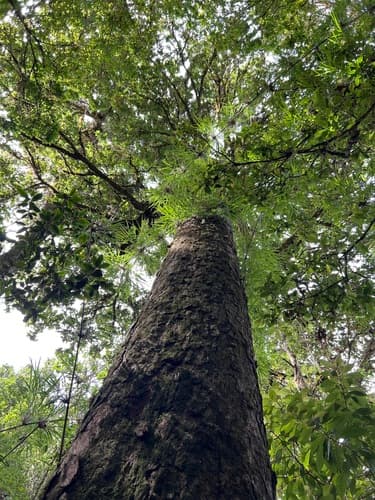
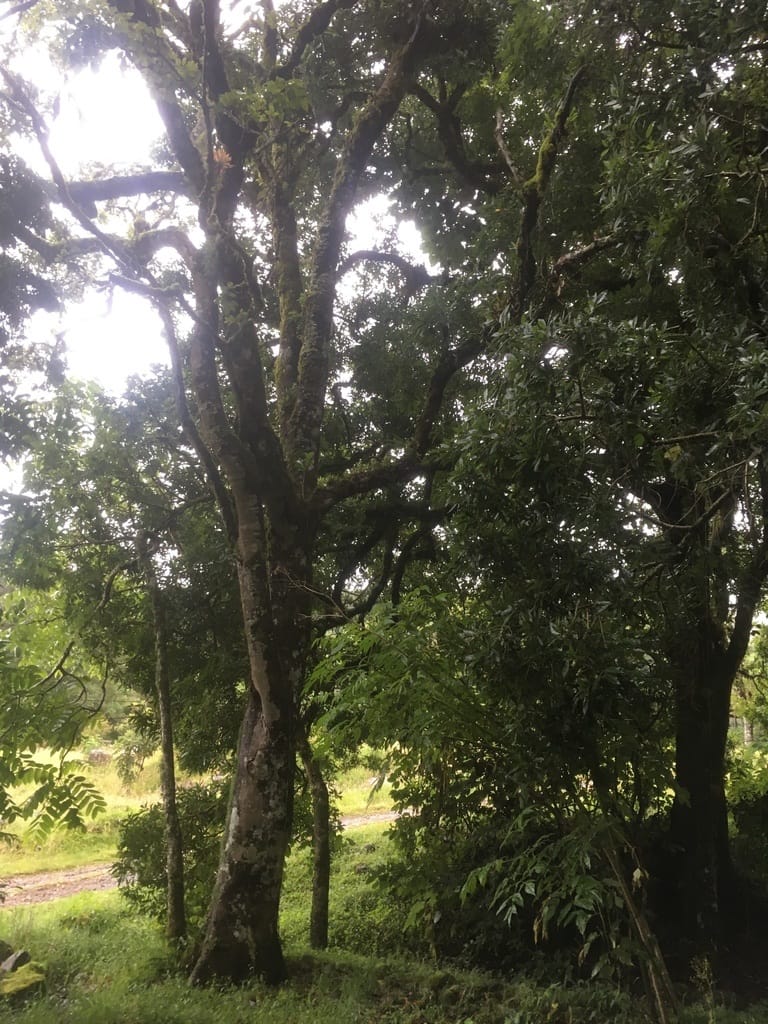
Whole tree in habitat
📷 (c) timendez, some rights reserved (CC BY-NC)(CC BY-NC)
View source ↗Bark detail
📷 (c) Josue Jimenez, some rights reserved (CC BY-NC)(CC BY-NC)
View source ↗Young stem detail
📷 (c) ariel_delgado, some rights reserved (CC BY-NC)(CC BY-NC)
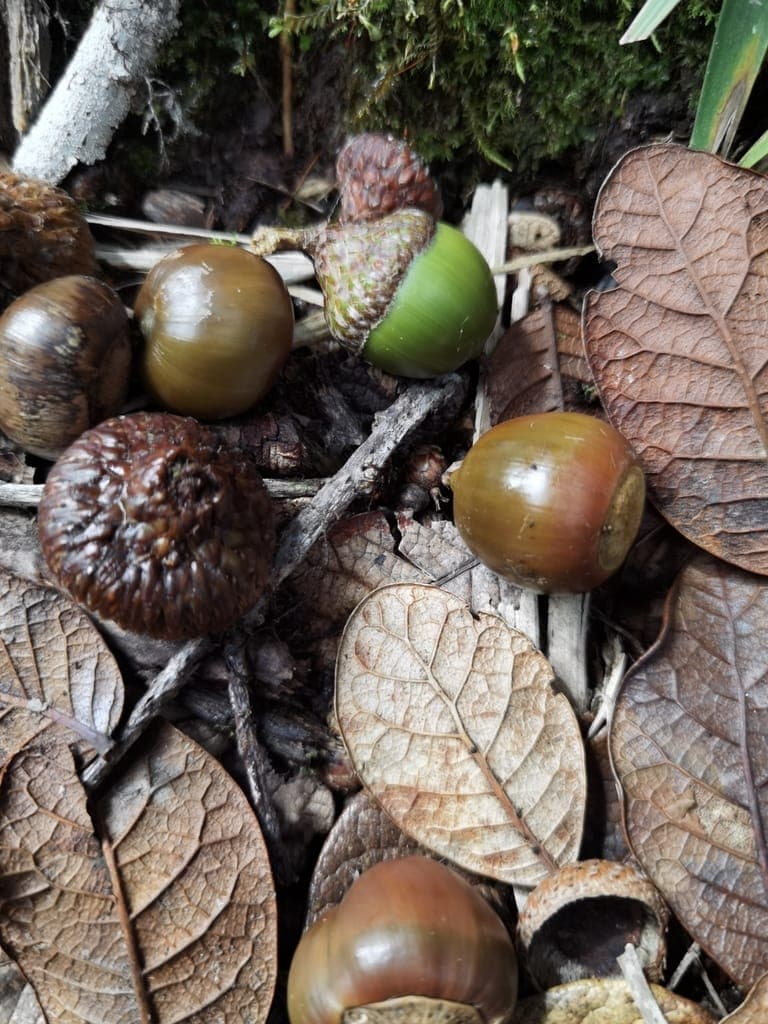
View source ↗Leaves, fresh and dried
📷 (c) Leonardo Álvarez-Alcázar, some rights reserved (CC BY-NC)(CC BY-NC)
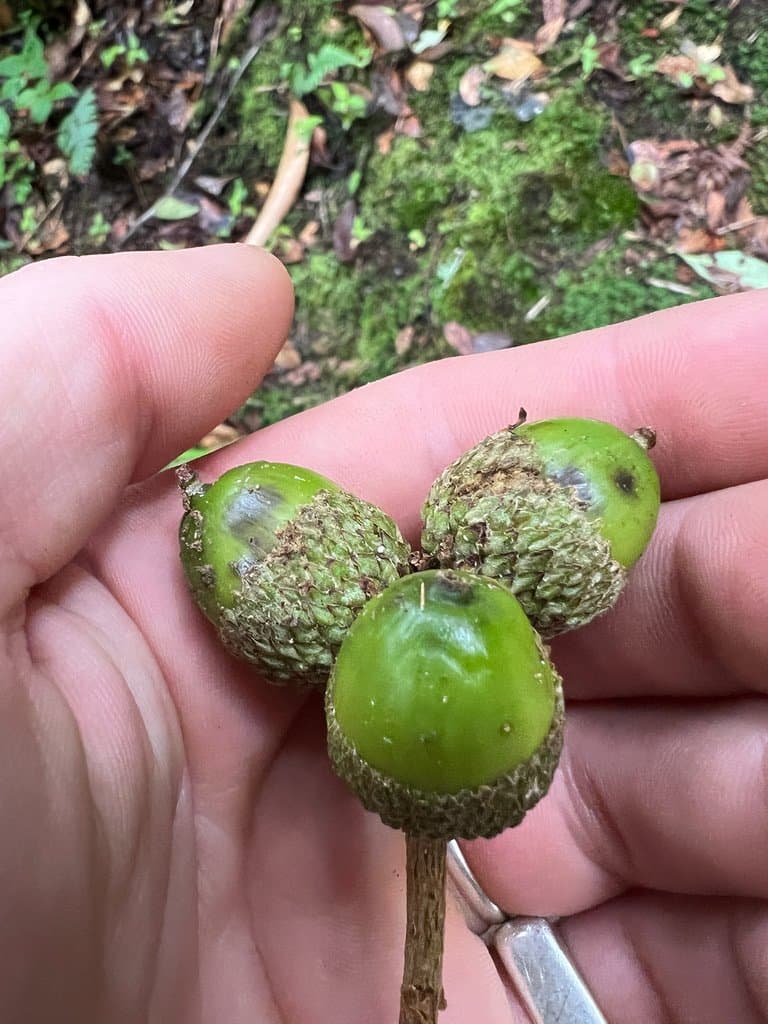
View source ↗Immature acorns with leaves
📷 (c) timendez, some rights reserved (CC BY-NC)(CC BY-NC)
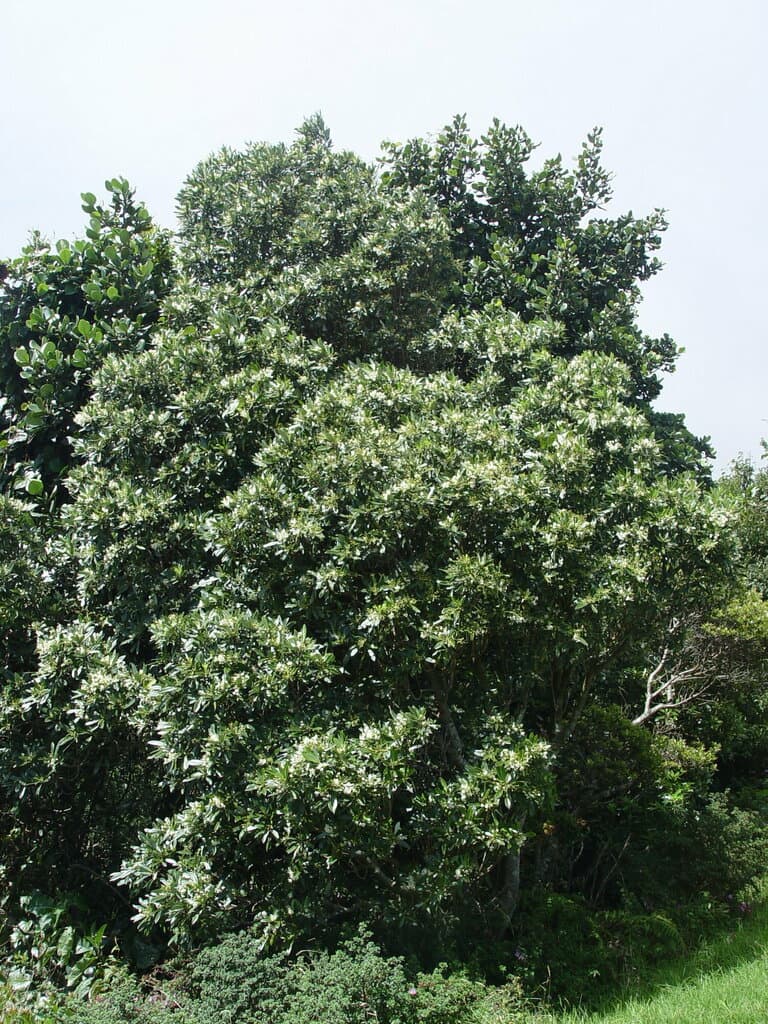
View source ↗Foliage in cloud-forest fog
📷 (c) Josue Jimenez, some rights reserved (CC BY-NC)(CC BY-NC)
View source ↗Photos sourced from iNaturalist's community science database, all from independently verified Costa Rica observations with confirmed CC BY-NC licensing (whole tree, bark, young stem, leaves at two states, and immature acorns). This atlas was not able to source a dedicated flower/catkin photograph or a mature brown acorn at time of publication. Browse all Roble Corrugata observations in Costa Rica →↗ (19 total at time of writing — the smallest Costa Rican observation count of any oak profiled in this atlas so far). If you have additional quality images, please contribute through our photo submission page.
Taxonomy
This is the most important disclosure on this page. This atlas's existing Roble Encino entry is an intentional generic profile covering roughly 25 Costa Rican Quercus species collectively, spanning 1,500-3,500 m — it is not a single-species page. Independent Costa Rican academic literature (a Universidad Nacional seedling-identification field guide, part of a series on native tree seedlings) documents "Encino gris" and "Roble encino" as common names specifically for Quercus corrugata — meaning the generic placeholder's own name is, in at least one real source, attached to this exact named species. This atlas did not rename or edit the existing Roble Encino page as part of adding this one. Two facts are true at once: (1) Quercus corrugata is a single, well-defined, formally described species with its own taxonomy, distribution, and conservation assessment, distinct from a 25-species generic group; and (2) the Costa Rican common name most directly documented for it in academic literature collides with that group's placeholder name. This page uses "Roble Corrugata" — built from the scientific epithet — specifically to avoid asserting a disambiguated common name this atlas cannot fully verify as exclusive to this species. Whether the atlas's Roble Encino page should eventually be split, cross-referenced, or partly absorbed into species-level pages like this one is a genuine open editorial question, not resolved by this page.
Common Names by Region
No indigenous-language name for this species was identified in the sources consulted for this page (POWO, GBIF, IUCN, UNA field guide, Área de Conservación Guanacaste, academic literature). If a Bribrí, Cabécar, or other indigenous name for Roble Corrugata exists, it has not yet been documented here and would require review under this atlas's indigenous knowledge governance policy before addition.
Etymology and Taxonomic Notes
- Genus Quercus: the classical Latin name for oak.
- Species epithet corrugata: Latin, "wrinkled" or "corrugated" — describing the characteristic wrinkled, rugose texture of the mature upper leaf surface.
- Authority: British botanist Sir William Jackson Hooker, who published the species in Hooker's Icones Plantarum, vol. 5, table 403 (1842).
- Placement: section Quercus (the "white oak" group) within genus Quercus, per Wikipedia's taxonomic summary sourced to Plants of the World Online — the same section as this atlas's Chicalaba (Quercus insignis), and distinct from Roble de Altura's section Lobatae (red oaks).
- Synonyms recognized by GBIF/POWO include Quercus aaata C.H.Mull., Quercus pilgeriana Seemen, and Quercus yousei Trel. — names from regional collections across the species' wide range before consolidation under Q. corrugata.
- GBIF usage key: 2880406, confirmed accepted and current as of this writing, with genus key 2877951 (the same genus-level key used by this atlas's Roble Encino entry) and publication citation "Hooker's Icon. Pl. 5: t. 403 (1842)."
Geographic Distribution
Geographic Distribution
Roble Corrugata's native range extends from southern Mexico (Hidalgo, Veracruz, Puebla, Oaxaca, Chiapas) through Guatemala, Belize, Honduras, El Salvador, and Nicaragua to Costa Rica and western Panama — one of the broadest ranges of any Mesoamerican highland oak (Wikipedia, sourced to the IUCN Red List assessment; GBIF distribution record). Within this range it inhabits humid montane cloud forest, typically as a canopy or emergent tree rather than in the near-monodominant stands formed by some other Talamancan oaks.
Where Roble Corrugata Grows in Costa Rica
Confirmed habitat:
Elevation: Sources converge on a broad band. Multiple independent sources (Wikipedia, sourced to the IUCN assessment; general Mesoamerican-oak literature) cite 700-2,200 m, with the ACG's own Costa Rican field profile recording specimens at approximately 556-600 m on the lower slopes of Volcán Orosí — slightly below the commonly cited range floor. This atlas uses 700-2,200 m as the primary Costa Rican range while noting the ACG's lower-elevation field record as a documented exception.
Costa Rica's montane oak forest ecoregion was, before this session's three new oak pages (Chicalaba, Roble de Altura, and this page), the single most under-covered ecoregion in this atlas. Roble Corrugata is the widest-ranging of the three, both geographically (Mexico to Panama, versus the other two species' Costa Rica/Panama-only ranges) and in elevation (700-2,200 m, spanning the lower and middle bands that Chicalaba and Roble de Altura only partly cover). It is also the only one of the three assessed as Least Concern rather than Vulnerable or Endangered — a genuinely different conservation story worth telling in its own right.
Habitat
Roble Corrugata occupies Costa Rica's montane and cloud-forest belt across a wider elevation range than the country's higher-elevation named oaks. A 2012 field study conducted in the Monteverde Cloud Forest Reserve (Cordillera de Tilarán) surveyed macrofungi across 30 oak trees on ridges and peaks, comparing Quercus corrugata and Quercus insignis (Chicalaba) as substrates for fungal diversity; the study documented 33 fungal species associated with Q. corrugata specifically, out of 64 total species recorded across both oak species and various substrates (acorns, soil, roots, leaf litter). This is one of relatively few dedicated ecological field studies naming this species specifically within Costa Rica.
The Área de Conservación Guanacaste, which documents the species on the slopes of Volcán Orosí, describes it as growing there to about 40 m with a 2 m trunk diameter, but explicitly notes it is "not very abundant" in that habitat — a direct, honest field-density observation from a Costa Rican conservation authority, rather than a broad range-wide population claim.
Botanical Description
How to Identify
Look for a large montane-forest oak with glossy, leathery, lance-shaped leaves bearing small regular marginal teeth (denticulate margin) and a pointed tip; the mature leaf surface often shows a wrinkled, corrugated texture, especially as it dries. Young stems and new leaf bases frequently show a distinctive pink coloration. Where present, small green acorns (roughly 3 cm) with a dry gray cupule, borne singly or in pairs, help confirm identification. Elevation (roughly 700-2,200 m, cloud forest) is consistent with all three of this atlas's named highland oaks, so leaf and acorn features — not elevation alone — are the more reliable cues for distinguishing this species from Chicalaba or Roble de Altura.
Ecological Role
Roble Corrugata functions as a canopy or emergent tree within Costa Rica's montane cloud-forest belt, spanning a wider elevation range than the country's other named highland oaks and therefore bridging habitat between lower montane forest and the higher-elevation oak-cloud forest dominated by species like Roble de Altura. As documented in the 2012 Monteverde macrofungal study, its trunk and associated substrates (leaf litter, roots, fallen acorns) support a measurable diversity of fungal species — 33 species recorded on this species specifically in that study — indicating a meaningful role as a fungal-diversity host within cloud-forest ecosystems, alongside its role as forest structure.
Heavy Seed Predation, Documented Directly
A Fossil Record Unique Among This Atlas's Oaks
Uses and Applications
This atlas found less species-specific ethnobotanical or commercial-use documentation for Roble Corrugata than for some other Costa Rican hardwoods. The uses below reflect general oak-family patterns documented in the broader literature for this species' Mesoamerican range, not a confirmed, dedicated Costa Rican commercial trade — a distinction this atlas is making deliberately rather than assuming one from the other.
Fuelwood, Charcoal, and Construction
General literature on Mesoamerican oaks documents fuelwood, charcoal production, and construction timber as common uses of Quercus species across the region, including within this species' range. This atlas did not find a dedicated, Costa Rica-specific source confirming commercial-scale harvest of Quercus corrugata specifically — the uses noted here reflect genus-wide and regional patterns rather than documented Costa Rican trade data for this species.
Scientific and Research Value
The clearest, best-documented "use" of this species in Costa Rica is scientific: it has been the subject of a formally published paleoclimate study (Pérez & Laurito, 2003) using fossil acorn impressions to reconstruct Pleistocene climate conditions, and a field ecology study comparing macrofungal diversity between this species and Chicalaba at Monteverde (2012). Both represent genuine, citable Costa Rican research specifically naming this species — a research base this atlas notes honestly is narrower than for some other profiled trees, but real as far as it goes.
Sources: Área de Conservación Guanacaste species profile↗, Pérez, E.A. & Laurito, C.A. (2003), Revista Geológica de América Central↗, USF Digital Commons — Monteverde macrofungal diversity study (2012)↗
Cultural Significance
This atlas found little independently sourced material specifically documenting Costa Rican cultural or ceremonial significance for Roble Corrugata as distinct from Costa Rica's other highland oaks. Rather than extend this section with plausible-sounding but unverified claims, it is kept short and limited to what is source-backed.
Costa Rica's montane cloud forests carry substantial cultural and national-identity weight as a habitat type — including the Monteverde Cloud Forest Reserve, one of the country's most internationally recognized conservation and ecotourism destinations, and one of the confirmed locations where Roble Corrugata grows and has been directly studied. As a component species of that forest type and a documented research subject there, Roble Corrugata shares indirectly in that broader cultural and scientific identity, even though this atlas did not find species-specific ceremonial, culinary, or folkloric documentation naming Quercus corrugata individually in Costa Rican cultural sources.
No indigenous name, use, or narrative for this species was identified during research for this page. Per this atlas's governance policy, any future indigenous-knowledge content about Roble Corrugata would need to go through the consent and review process described in Indigenous Knowledge Governance before being added — it is intentionally absent here, not merely unresearched.
Safety
Roble Corrugata carries the same general safety profile as oaks generally: low-level tannin content in acorns and leaves, no skin-contact hazard, and a moderate wind-pollinated allergen risk. Its broader elevation range means somewhat more incidental human contact (hikers, reserve visitors) at its lower-elevation sites than Costa Rica's higher-elevation oaks.
Toxicity
Roble Corrugata's acorns and foliage, like those of oaks generally, contain tannins that hydrolyze into compounds such as gallic acid. In humans, casual contact or accidental tasting is not a medical emergency; the strong bitterness of raw tannins discourages overconsumption, and acorns are inedible raw in any quantity without processing (soaking and cooking) to leach tannins out — a preparation method documented for other oak species' acorns used as human food, though not confirmed here as a specific Costa Rican practice for this species.
Allergen Risk
Oaks are wind-pollinated, and their fine pollen is a well-documented seasonal allergy trigger in oak-forest regions generally. Roble Corrugata's broader elevation range (down to roughly 700 m) puts it somewhat closer to trail networks, reserve infrastructure, and rural settlements than Costa Rica's higher-elevation oaks, modestly increasing the population that might experience seasonal exposure during the March-May flowering window, though still well below the exposure level of an urban-planted tree.
Pet and Wildlife Safety
Veterinary sources document that acorns from oak species generally can cause gastrointestinal upset in dogs (vomiting, diarrhea, abdominal pain) if eaten in quantity, and that cattle and horses grazing heavily on acorns or wilted oak leaves have, in some studied oak species, developed tannin-related kidney and liver injury. No case reports specific to Quercus corrugata were located during this review — the above reflects general oak-family veterinary literature, applied here as a precaution rather than a species-specific finding. Wildlife adapted to Costa Rican cloud forest — including squirrels, parrots, peccaries, guatusas, and pacas — directly and heavily consume this species' acorns as a normal, non-toxic food source, per the Área de Conservación Guanacaste's own field observations.
Sources: PMC — Suspected acorn (Quercus petraea) toxicity in a dog↗, Área de Conservación Guanacaste species profile↗
Conservation Status
Population trend: Presumed stable (no quantified range-wide decline documented)
Quercus corrugata was assessed globally as Least Concern by the IUCN Red List in 2018 (assessor: D. Jerome; IUCN taxon ID 89963078), reflecting its extensive distribution across southern Mexico and Central America and the absence of a quantified range-wide population decline. This assessment was independently cross-checked for this page against three separate sources — GBIF's own IUCN Red List category lookup (which returned "LEAST CONCERN" / code "LC" for GBIF taxon key 2880406, tied to IUCN taxon ID 89963078), Wikidata's identifier record, and secondary summaries citing the same Jerome (2018) assessment — all of which agree. This atlas was not able to directly load the IUCN Red List's own website during research (the site's anti-bot protection blocked automated access), so this status rests on the cross-verified GBIF/Wikidata chain described above rather than a direct read of iucnredlist.org; a human reviewer with browser access to iucnredlist.org/species/89963078 is encouraged to confirm the assessment criteria and rationale text directly. This atlas did not find a Costa Rica-specific national (SINAC) conservation listing for this species — a direct check of the text of Decreto N°25700-MINAE (Costa Rica's national logging-ban/veda list for endangered timber species) found no Quercus species listed at all (the only conifer-family relative listed is Podocarpus); no SINAC national status is asserted here.
Quercus corrugata is not listed on any CITES Appendix. This atlas checked independently rather than assuming CITES status transfers within the genus or from this atlas's other oak pages: a review of the Wikipedia compilation of the full CITES Appendix III species list found only one Quercus entry anywhere in any CITES Appendix — Quercus mongolica (Mongolian oak), listed on Appendix III by the Russian Federation only, covering only that species' Russian population. No Mesoamerican or Neotropical oak, including Q. corrugata, appears on any CITES Appendix.
Documented Threats
- General cloud-forest habitat pressure. Broader Mesoamerican literature documents deforestation for agriculture and logging as an ongoing pressure on cloud-forest habitat across this species' range, though this atlas found no quantified, species-specific population-decline figure attached to Q. corrugata itself — consistent with its Least Concern assessment.
- Coffee cultivation conversion. In parts of the Mexican range (Veracruz, Chiapas), conversion of cloud forest to shade-grown coffee cultivation has been documented as reducing habitat connectivity for oak-dominated plant communities generally.
- Heavy seed predation. The Área de Conservación Guanacaste's field profile for its Volcán Orosí population explicitly attributes the species' local scarcity there to heavy predation of acorns by squirrels, parrots, peccaries, guatusas, and pacas — a naturally occurring ecological constraint on local recruitment rather than an anthropogenic threat, but a real limit on this species' local abundance even inside a protected area.
Conservation Strengths
- Wide range, Least Concern status. Unlike this atlas's other two named highland oaks, Roble Corrugata's Mexico-to-Panama range and Least Concern assessment mean it does not currently carry a documented extinction risk at the global scale.
- Presence within protected areas. The species is directly documented within the Área de Conservación Guanacaste (Sector Pitilla, Sector Orosí) and the Monteverde Cloud Forest Reserve — both established conservation areas — in addition to its presence across the Talamanca range shared with this atlas's other profiled oaks.
- A real, if narrow, research base. Two independent, citable Costa Rican studies — a 2003 paleoclimate paper using fossil acorns and a 2012 field study of macrofungal diversity — name this species specifically, providing a foundation for future work even though this atlas found less dedicated ecological literature on it than on Chicalaba or Roble de Altura.
- Priority gaps that remain. This atlas did not find a dedicated population-monitoring program, genetic study, or propagation protocol specific to this species in Costa Rica, unlike the more actively studied Roble de Altura and Chicalaba — a gap a future update to this page could address as new sources become available.
Sources: GBIF species distribution and IUCN status record↗, Wikipedia — Quercus corrugata, citing Jerome, D. 2018 IUCN Red List assessment↗, Área de Conservación Guanacaste species profile↗, List of species protected by CITES Appendix III (Wikipedia compilation)↗, Decreto Ejecutivo N°25700-MINAE (Costa Rica national veda/logging-ban list)↗
External Resources
Global occurrence and distribution data, including the IUCN-sourced Least Concern status
GBIF
Kew's authoritative taxonomic record, including synonymy
Kew Science
Official 2018 conservation assessment (Jerome, D.) — direct automated access was blocked during this page's research; please verify live
IUCN
19 Costa Rica observations and community photos at time of writing
iNaturalist
Costa Rican field data: distribution, elevation, description, fruiting phenology, seed predation
ACG / SINAC
General botanical and distribution summary, citing the IUCN assessment
Wikipedia
References
📚 Scientific References & Further Reading
Jerome, D. (2018). Quercus corrugata. The IUCN Red List of Threatened Species 2018: e.T89963078A89963082. IUCN Red List of Threatened Species. doi:10.2305/IUCN.UK.2018-2.RLTS.T89963078A89963082.en
Hooker, W.J. (1842). Quercus corrugata. Hooker's Icones Plantarum 5: t. 403
Pérez Gamboa, E.A. and Laurito Mora, C.A. (2003). Quercus corrugata Hooker (Fagaceae) como indicador paleoclimático del Pleistoceno de Costa Rica. Revista Geológica de América Central 28: 83-90
Área de Conservación Guanacaste (2026). Quercus corrugata (Fagaceae) — species profile. acguanacaste.ac.cr
[Author per USF Digital Commons record] (2012). Macro fungi species richness between two oak tree species (Quercus insignis and Quercus corrugata). Monteverde Institute Tropical Ecology and Conservation Collection, USF Digital Commons
Universidad Nacional de Costa Rica (UNA) (2026). Fagaceae Quercus corrugata, 'Encino gris, Roble encino' — seedling identification profile. Fichas de Semillas y Plántulas (UNA field guide series)
Roble Corrugata grows across a broader stretch of elevation and geography than any other named oak in this atlas — from Mexico to Panama, and from 700 to 2,200 meters within Costa Rica alone. It is the only one of this atlas's three named highland oaks not currently considered threatened. But it also carries this atlas's most direct naming tension: Costa Rican academic sources document "Roble encino" as a common name for this exact species, the same name already used here for a different, generic 25-species placeholder page. This page resolves that tension by using a distinct, transparent name rather than picking a side — the underlying editorial question of whether to eventually split or cross-link the two pages is left for human review. Real field photography of flowers and mature brown acorns, a closer look at the height discrepancy noted above, and the same careful, consent-based check for any indigenous name are all still open work.
🌳 ¡Pura Vida!
Safety Information Disclaimer
Safety information is provided for educational purposes only. Individual reactions may vary significantly based on age, health status, amount of exposure, and individual sensitivity. Always supervise children around plants. Consult a medical professional or certified arborist for specific concerns. The Costa Rica Tree Atlas is not liable for injuries or damages resulting from interaction with trees described in this guide.
• Always supervise children around plants
• Consult medical professional if unsure
• Seek immediate medical attention if poisoning occurs
Information compiled from authoritative toxicology sources, scientific literature, and medical case reports.
Help improve this page
Know something about this tree? Share local knowledge, suggest a correction, or submit a photo to improve this guide for everyone.